The $400 Million Failure: 5 Lessons from Sony's Concord
Concord made a lot of noise to drum up hype before release - only to go out with barely a whimper. Find out what made a multimillion-dollar project make an unceremonious exit in a span of less than a month.
The popular hero shooters of the time were (and still are) Apex Legends, Overwatch 2, Paladins, and even Valorant. If there are similarities between them, it’s the top-quality shooter gameplay and they’re free-to-play. That’s right. No initial purchase is needed: simply download, make an account, and play. The choices go broader if other live service shooters like Fortnite are added to the selection. Given what’s offered to the gamer at the time, there’s hardly any reason to purchase the game when most of the free counterparts offer the same level of excitement.
Appealing to pride and questioning sensibilities can be made effective – that is if the items in question are luxury goods made to draw purchases out of a hurt buyer’s pride. That’s not the case with Concord. Conspiracy theories about the development team’s attitudes towards their customer base, followed by Sony’s attempts at pumping active player numbers failed to make the game endearing to the intended audience. Those who benefited from Concord are the trophy hunters who rushed to get Platinum in two weeks.
The marketing direction here is rather interesting. Despite the timeline of how long the game was made, there was hardly any advertising trickled until only two months before the launch date. There was only enough noise to be made that some players managed to find out the launch date as late as the week before Concord intended to make its big debut.
Concord tried to pitch in 70’s sci-fi aesthetics to a 21st-century audience – and none of that stuck in the end. While there are arguments to be made on both sides of those for and against identity politics, the available avatars in Concord are worth not more than negative memes. What makes this worse is that each character’s gunplay is hardly different from each other – special effects aside. It has good gameplay mechanics, but that won’t be enough to make it rise to the top of the highly competitive multiplayer subgenre.
These are the top don’ts when it comes to developing and promoting a game. Both Sony and Firewalk Studios either played too safe or thundered on the wrong set of drums. Either way, two weeks was more than enough to close Concord for good and move on to other projects.
Check out more games that failed on their developmental life cycle in Shutdown Games.
A game with a multi-million dollar budget and an 8-year development table shouldn’t be set to failure. While it is hard to believe at first, they do happen, and these instances are the reason such games become a spectacle of what not to do when it comes to creating and hosting digital escapades.
Enter Concord: a futuristic hero shooter backed with the usual AAA game marketing campaign and (badly executed) massive hype. While doomsayers weren’t particularly shy of predicting its fate even on the week before its launch, news of its Concord's closure shocked only a few.
So, what lessons can be learned from Sony’s big disaster of a project?
The $40 Hero Shooter
The popular hero shooters of the time were (and still are) Apex Legends, Overwatch 2, Paladins, and even Valorant. If there are similarities between them, it’s the top-quality shooter gameplay and they’re free-to-play. That’s right. No initial purchase is needed: simply download, make an account, and play. The choices go broader if other live service shooters like Fortnite are added to the selection. Given what’s offered to the gamer at the time, there’s hardly any reason to purchase the game when most of the free counterparts offer the same level of excitement.
Questionable marketing tactics
Appealing to pride and questioning sensibilities can be made effective – that is if the items in question are luxury goods made to draw purchases out of a hurt buyer’s pride. That’s not the case with Concord. Conspiracy theories about the development team’s attitudes towards their customer base, followed by Sony’s attempts at pumping active player numbers failed to make the game endearing to the intended audience. Those who benefited from Concord are the trophy hunters who rushed to get Platinum in two weeks.
The marketing direction here is rather interesting. Despite the timeline of how long the game was made, there was hardly any advertising trickled until only two months before the launch date. There was only enough noise to be made that some players managed to find out the launch date as late as the week before Concord intended to make its big debut.
Unappealing characters
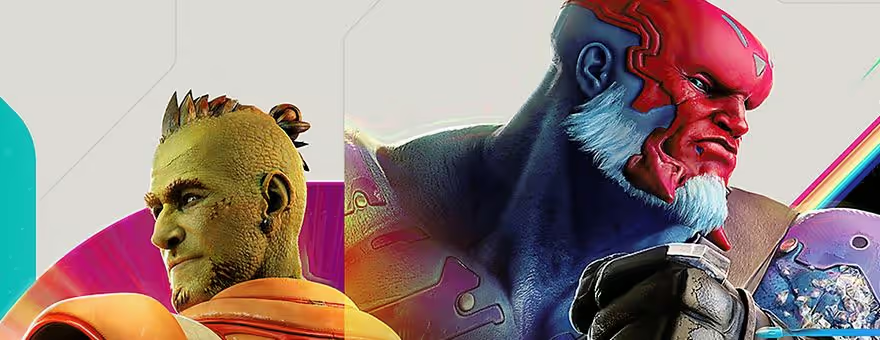
Concord tried to pitch in 70’s sci-fi aesthetics to a 21st-century audience – and none of that stuck in the end. While there are arguments to be made on both sides of those for and against identity politics, the available avatars in Concord are worth not more than negative memes. What makes this worse is that each character’s gunplay is hardly different from each other – special effects aside. It has good gameplay mechanics, but that won’t be enough to make it rise to the top of the highly competitive multiplayer subgenre.
These are the top don’ts when it comes to developing and promoting a game. Both Sony and Firewalk Studios either played too safe or thundered on the wrong set of drums. Either way, two weeks was more than enough to close Concord for good and move on to other projects.
Check out more games that failed on their developmental life cycle in Shutdown Games.